1
Normalize values
Use the absolute value of each integer because common divisors are positive.
Find the greatest common factor of two or more integers, then see why the answer is correct with factor lists, prime factors, and Euclidean steps.
The GCF is the largest positive integer that divides every input with no remainder. It is also called the GCD or HCF.
Every common factor divides 4; the greatest is 4.
The intersection of all these lists contains the shared factors. The largest one is 4.
To reduce a fraction, divide its numerator and denominator by their GCF. The value stays the same while both numbers become easier to work with.
The greatest common factor is the largest positive integer that divides every number in a set without a remainder. This calculator applies the Euclidean algorithm pairwise, so it works for two or more integers.
Use the absolute value of each integer because common divisors are positive.
Repeatedly divide and keep the remainder until the remainder is zero.
Use the current GCF with the next integer until every input is included.
72 mod 48 = 24, 48 mod 24 = 0, so the greatest common factor is 24.
Common factors → greatest one
List the factors of each small number and choose the largest factor that appears in every list.
GCF = product of shared prime powers
Factor each number and multiply the prime factors shared by all inputs, using the lowest exponent.
GCF(a,b) = GCF(b, a mod b)
Use remainders instead of long factor lists. This is fast for large integers and produces the steps shown above.
| Numbers | GCF | Why |
|---|---|---|
| 8, 12, 20 | 4 | 4 divides all three numbers |
| 48, 72 | 24 | 24 is the largest shared divisor |
| 15, 22 | 1 | The numbers are coprime |
| 0, 36 | 36 | GCF(0, n) = |n| |
Divide the numerator and denominator by their GCF to reduce a fraction.
Reduce a ratio to its simplest whole-number form.
Find the largest group size that divides several quantities evenly.
Check whether a set of integers is coprime and explore shared factors.
The greatest common factor is the largest positive integer that divides every number in a set. For example, GCF(8, 12, 20) = 4.
Yes. Greatest common factor (GCF), greatest common divisor (GCD), and highest common factor (HCF) are different names for the same value.
Enter between 2 and 50 integers. Commas, spaces, semicolons, and line breaks are all accepted.
For a non-zero integer n, GCF(0, n) = |n|. GCF(0, 0) is undefined because every integer divides zero.
Yes. The calculator uses absolute values, so GCF(-48, 72) is 24.
A GCF of 1 means the integers are coprime or relatively prime. They have no shared factor greater than 1.
Write each integer as prime factors, keep only primes present in every factorization, and use the lowest exponent of each shared prime.
Find the GCF of the first two numbers, then find the GCF of that result and the next number. Continue until the full list is included.
The GCF is the largest shared divisor. The LCM is the smallest positive shared multiple. For two non-zero numbers, GCF × LCM = |a × b|.
This calculator is for integers. Clear fraction denominators or convert decimal values to an equivalent whole-number ratio before finding a GCF.
GCF helps reduce each fraction before addition. The related LCM of the denominators gives the least common denominator when fractions need to be combined.
Divide both the numerator and denominator by their GCF. For 48/72, divide by 24 to get the reduced fraction 2/3.
Useful tools selected for this workflow
Find the least common multiple of two or more integers with exact BigInt results, GCF, prime factorization, formulas, and calculation steps.
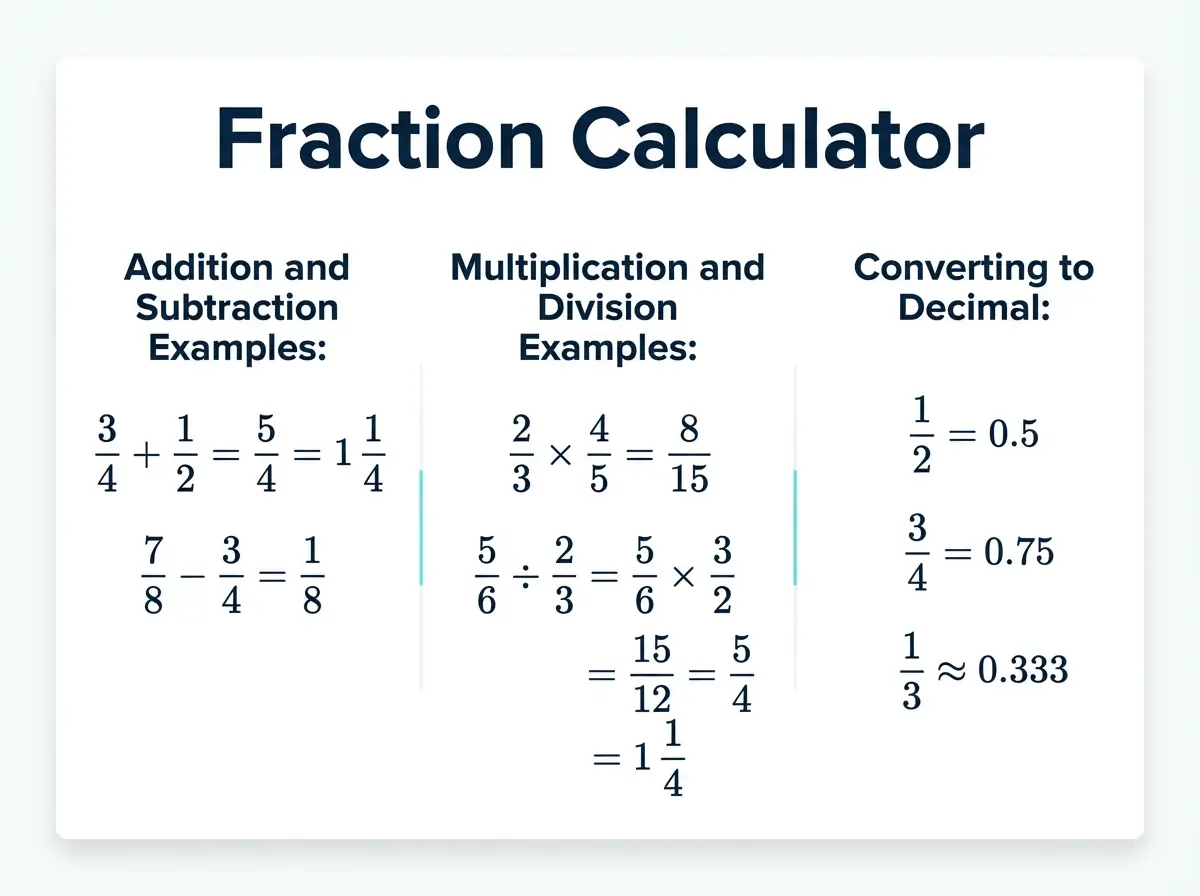
Add, subtract, multiply, and divide fractions. Simplify fractions, convert decimals, and work with mixed numbers easily.
Calculate the missing side of a right triangle using the Pythagorean theorem (a² + b² = c²). Free online calculator with step-by-step solutions.
Calculate the average, sum, count, median, mode, range, minimum, maximum, and weighted average for a list of numbers.
Solve A:B = C:D, find missing ratio values, simplify equivalent ratios, scale proportions, calculate percentages, and view ratio diagrams.

Find exact and decimal distances between two points in 2D or 3D with coordinate differences, midpoint, and step-by-step formulas.